
IN THE DUST
It Passed a Ducati at 130
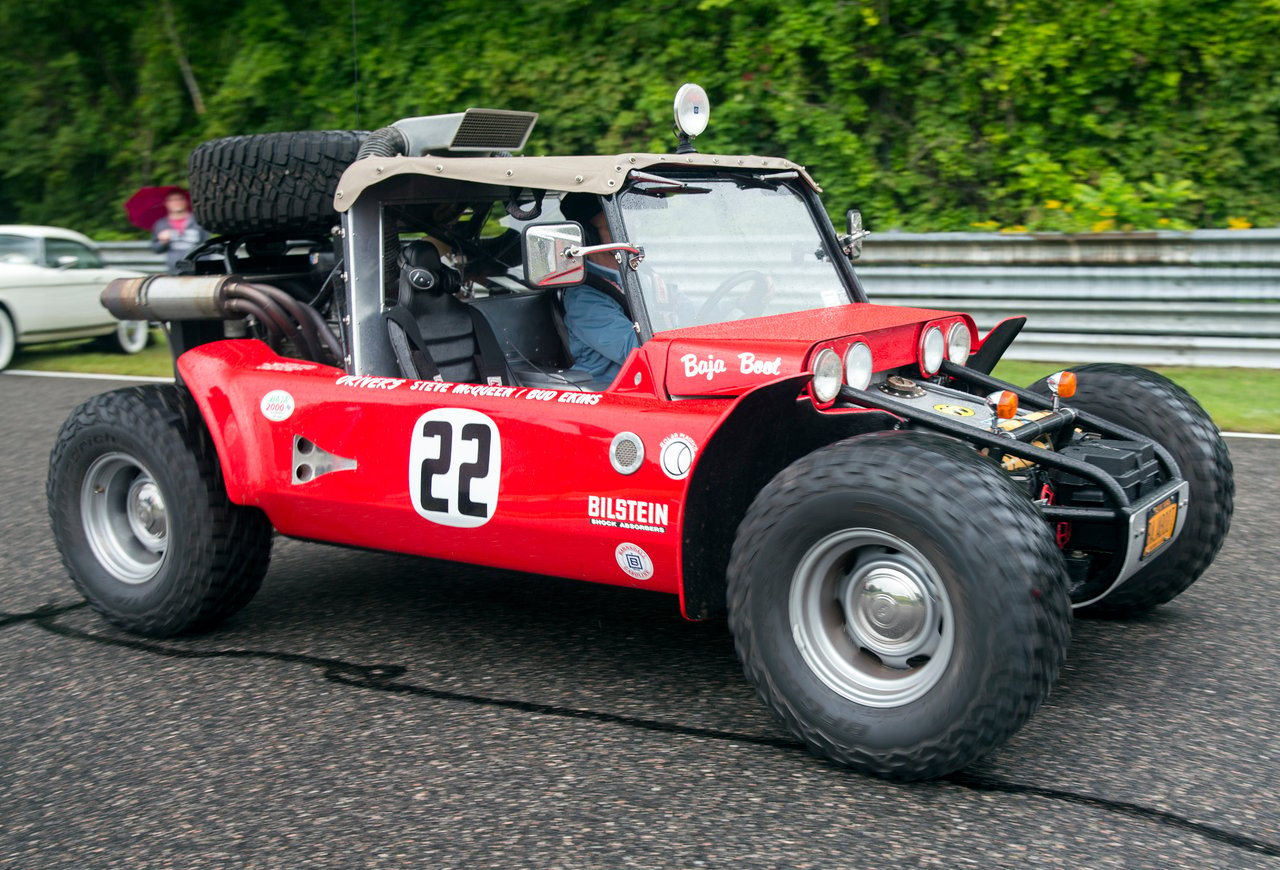
Vic Hickey’s mid-engine Baja Boot — built in under a month for the 1967 Mexican 1000 — finally earned its name when Bud Ekins and Guy Jones won the inaugural 1969 Baja 500 after Cycle World watched it pass a Ducati at over 130 mph.
Updated September 11, 2026
June 1969. First NORRA Baja 500. A shortened peninsula fight — pavement, graded dirt, soft sand, rocks, night straights — and somewhere out there a Ducati is doing ninety when something the size of a boot and the power of a Camaro goes by at over 130.
Cycle World's Joseph C. Parkhurst wrote it while the dust was still settling: the Baja Boot, driven by Bud Ekins and Mike Jones, passed the bike on a straight stretch. The Boot finished first. A VW buggy was second. The Ducati — Douglas and McClurg, motorcycle class winners — was third overall. The peninsula had just watched a purpose-built mid-engine monster cash the check Vic Hickey wrote two years earlier.
That is the consequential moment. Not a résumé. A clock, a pass, and a machine that finally earned its ugly name.
Hickey did not build the Boot to look pretty. He built it because NORRA had announced a real race down Baja — the Mexican 1000, October 31, 1967 — and the existing fleet of cut-down Beetles, Jeeps, and warmed-over trucks was not the answer he wanted. Off-road historian Marty Fiolka later called it the first true off-road supercar: roughly $78,000 in an era when a Manx-style buggy could be slapped together for a few hundred bucks. Wheelbase around 112 inches. Wet weight around 3,450 pounds. Mid-mounted small-block. Four-wheel drive. Independent suspension. Huge Goodyear “Baja Special” tires. Hurst money on the side. It looked, in Hickey's own blunt framing, like an old boot.
The build clock is part of the legend. Bonhams' auction history puts the first Boot together in 26 days after the team had to spirit the unfinished car out of GM's Detroit skunkworks — corporate “no racing” policy catching up — and finish it in a Hurst garage. ORMHOF rounds the same sprint to about 30 days. Either way, it was not a leisurely winter project. Drino Miller and Al Knapp took it to the starting line of that first Mexican 1000. It did not finish. Speed showed up early; a rear strut (ORMHOF) or transmission trouble, depending which later summary you trust, sent the Boot home. The machine named for Baja had not yet won Baja.
Steve McQueen's Solar Plastics Engineering bought both Boots. By June 13, 1968, they were wearing Solar Plastics paint at the Stardust 7-11 in Las Vegas. Matt Stone's McQueen Machines book preserves the actor's own punch line from that weekend: they were batting along, feeling good, when a big fat wheel rolled along beside them. It had been attached to their Boot. DNF. The 1969 Mexican 1000 try ended the same way — another transmission part, another unfinished peninsula. Hollywood ownership did not magically make the Boot reliable. It made the Boot famous while Hickey's engineering still had to earn the result.
It earned it in June 1969, on the inaugural Baja 500.
SCORE's all-time Baja 500 overall champions table lists Bud Ekins / Guy Jones, Baja Boot-Olds, as the four-wheel winners of that first running. Wikipedia's Baja 500 table matches. Autoweek's 2003 Hickey obituary matches. Cycle World's contemporary race report from that same weekend names Ekins and Mike Jones. SCORE's later milestones page sometimes prints Gary Jones. The champions ledger and the Wikipedia consensus stay with Guy. Motorcycle overall that day: Doug Douglas / Jim McClurg on Ducati. Parkhurst counted 548 miles of mixed surface and said NORRA had laid the course so cars had an edge on the night straights and high-speed roads. The Boot used that edge the way a mid-engine V8 should.
Same calendar year, a different NORRA classic — the longer Mexican 1000 — went overall to a Stroppe Ford Bronco. Different race, different length, different argument. The Boot's claim is narrower and cleaner: first Baja 500, four-wheel overall, in the weirdest, most advanced thing on the entry list.
Background that explains why the pass still matters: Vic Francis Hickey, born 1919 in Akron, Ohio, raised into Southern California hot-rod and dry-lake culture, Navy WWII, Indy and Novi shop work, then the Trailblazer — his late-1950s Corvair-powered off-road concept that got Ed Cole's attention and a GM R&D job. ORMHOF inducted him in 1978 for design work that touched the Blazer story, lunar-vehicle development programs, the Baja Boot, and later the HMMWV/Humvee contract path. Road & Track's later profile is more careful on the moon piece — Hickey's Mobile Geological Lab and suspension concepts fed the program; he left before Boeing/GM built the flight Lunar Roving Vehicles. “Helped put tire marks on the moon” is Hall-of-Fame shorthand, not a solo inventor claim. He died of natural causes June 13, 2003, at 84, in California. Autoweek and ORMHOF agree on the date and age.
Only two original Boots were built. Boot 2 started life with an Oldsmobile engine in Hickey's California shop. The surviving display car now associated with the Glickenhaus collection — purchased at Bonhams Monterey 2008 for $199,500 after a ground-up restoration — is the one people point cameras at. In 2019 Fiolka wrote the modern punch line for RACER: a reborn Glickenhaus Boot lining up against a Ford Bronco R prototype at the SCORE Baja 1000, fifty years after Hickey and Stroppe defined opposite philosophies of desert speed. Factory muscle versus skunkworks weirdness. The argument never really ended.
Here is why that 130-mph pass still belongs in a feed full of Trophy Truck gloss.
Desert racing loves a clean origin myth. The Baja Boot refuses to be tidy. It was built too fast, banned by a corporate racing policy, unfinished at the race it was named for, sold to a movie star, broken by a loose wheel and a transmission, and then — on the first Baja 500 — finally faster than the bikes on the sections that favored lights and horsepower. Entertainment without invented dialogue. The stakes were real. The twist was patience after failure. The payoff was overall on a course Parkhurst said was changing the bike-versus-car argument in public.
If you stare at a modern unlimited buggy or a street-legal Glickenhaus Boot and think the mid-engine desert formula feels obvious, remember Vic Hickey named his answer after footwear and finished it in under a month because the calendar would not wait. June 1969 was when the name stopped being a joke and started being a result.
SOURCES
- Cycle World — Baja 500 (September 1969 contemporary race report)
- SCORE International — all-time Baja 500 overall champions
- Off-Road Motorsports Hall of Fame — Vic Hickey biography
- Bonhams — 1967 Baja Boot auction history and specifications
- Road & Track — How Vic Hickey Reshaped Off-Roading
- Autoweek — Off-road racing pioneer Vic Hickey dies
- RACER — Baja 1000 preview: It’s 1969 all over again (Marty Fiolka)